
Introduction
The engine is one of the most important systems in any piston-powered aircraft, and its condition directly affects aircraft reliability, performance, and safe operation. Unlike many automotive engines, aircraft piston engines operate in demanding conditions where temperature, vibration, operating hours, and maintenance practices can have a significant impact on component life. For aircraft owners, recognizing unusual engine behaviour early can help prevent minor issues from becoming more complicated maintenance problems.
Hard starting, rough operation, unusual noises, abnormal oil consumption, temperature changes, and unusual instrument readings are all signs that deserve attention. Some problems may be relatively simple, while others can indicate developing mechanical or system-related issues.
Understanding these warning signs does not mean aircraft owners should attempt complex repairs themselves. Instead, good knowledge helps owners communicate effectively with qualified aviation maintenance professionals and make informed maintenance decisions.
Understanding Piston Aircraft Engines
A piston aircraft engine converts the energy produced by combustion into mechanical power that turns the aircraft’s propeller.
Although engine designs vary, major components generally include:
- Cylinders
- Pistons
- Connecting rods
- Crankshaft
- Valves
- Spark plugs
- Magnetos
- Fuel system
- Oil system
- Cooling system
- Exhaust system
During operation, fuel and air enter the cylinders and are ignited by the ignition system. The resulting combustion pushes the pistons, which transfer movement through the connecting rods to the crankshaft. The crankshaft then provides rotational power to the propeller.
Because these components operate together under significant mechanical and thermal loads, a problem in one area can sometimes affect overall engine performance.
Regular inspections and proper maintenance are therefore essential for keeping a piston aircraft engine in reliable operating condition.
Common Piston Aircraft Engine Problems
1. Hard Starting or Starting Problems
Difficulty starting is one of the first engine problems an aircraft owner may notice.
A piston engine that repeatedly takes longer than expected to start can have issues involving several systems. Potential areas of concern include the ignition system, fuel delivery, battery or electrical system, spark plugs, or operating conditions.
Cold temperatures and aircraft storage conditions can also influence starting behaviour.
A single difficult start does not necessarily indicate a major engine problem. However, repeated starting difficulties should not become something an owner simply accepts as normal.
Keeping track of when starting problems occur can provide useful information to maintenance personnel. Details such as temperature, recent maintenance, storage conditions, and whether the problem is recurring may help with diagnosis.
2. Rough Engine Operation
A smooth-running piston engine should have consistent and predictable operation. Noticeable roughness can indicate a problem that deserves investigation.
Possible areas involved include:
- Ignition components
- Spark plugs
- Fuel delivery
- Mixture-related issues
- Cylinder performance
- Mechanical components
Rough operation may occur briefly under certain circumstances, but persistent or unexplained roughness should not be ignored.
Aircraft owners should report changes in engine behaviour to qualified maintenance personnel rather than assuming the problem will disappear on its own.
3. Excessive Oil Consumption
Oil plays a critical role in lubricating and protecting engine components. Aircraft owners should therefore pay attention to changes in normal oil consumption.
An increase in oil usage may have several possible explanations, including:
- Engine wear
- Cylinder condition
- Piston ring issues
- Oil leakage
- Operating conditions
- Changes in engine condition
The important factor is often the trend rather than a single observation.
Maintaining accurate records of oil consumption can help maintenance professionals identify changes over time. If oil usage begins increasing consistently, the engine should be evaluated according to appropriate maintenance procedures.
4. Low or Abnormal Oil Pressure
Oil pressure helps ensure that critical engine components receive adequate lubrication.
An abnormal oil pressure indication can therefore be an important warning sign. Depending on the circumstances, possible causes may involve the oil level, temperature, oil system, instrumentation, or internal engine condition.
Aircraft owners should never dismiss an unusual oil pressure indication simply because the engine otherwise appears to be operating normally.
The appropriate response depends on the aircraft and engine manufacturer’s procedures and the specific operating circumstances. Qualified maintenance personnel should investigate persistent or unexplained abnormalities.
5. High Cylinder Head Temperature
Cylinder head temperature provides useful information about engine operating conditions.
Persistently high temperatures can place additional stress on engine components and may contribute to accelerated wear if the underlying cause is not addressed.
Possible contributing factors can include:
- Operating conditions
- Cooling airflow
- Mixture settings
- Engine condition
- Environmental conditions
- Instrumentation issues
Owners should become familiar with the normal temperature behaviour of their aircraft and pay attention to unusual trends.
A recurring temperature problem deserves professional evaluation rather than being treated as an ordinary characteristic of the aircraft.
6. Spark Plug Problems
Spark plugs are essential parts of the ignition process in piston aircraft engines.
Over time, spark plugs can experience:
- Fouling
- Deposits
- Wear
- Contamination
- Ignition performance issues
Problems with spark plugs can contribute to rough engine operation, starting difficulties, or abnormal ignition performance.
Spark plug inspections are therefore an important part of piston engine maintenance.
Because aircraft ignition systems require specific inspection and maintenance procedures, owners should rely on appropriately qualified personnel for inspection, servicing, and replacement.
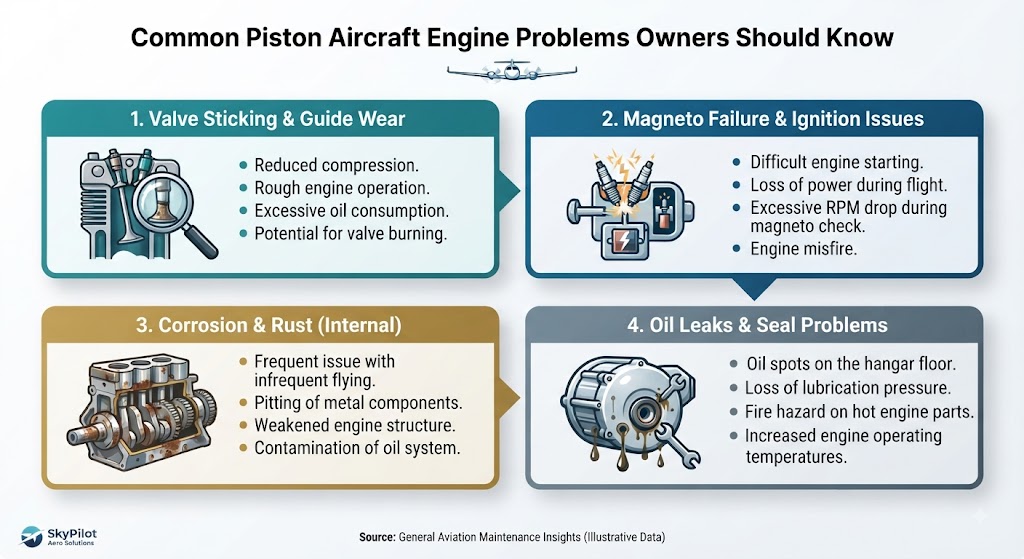
7. Magneto and Ignition System Problems
Many piston aircraft engines use magnetos as part of their independent ignition systems.
Issues within the ignition system can affect engine starting and operation.
Potential warning signs may include:
- Difficult starting
- Rough engine operation
- Abnormal ignition indications
- Changes in normal engine performance
Ignition problems should be addressed through approved inspection and maintenance procedures.
Because ignition systems are critical aircraft systems, owners should not attempt improvised repairs or modifications.
8. Fuel System Problems
The engine depends on a reliable supply of properly managed fuel.
Fuel-related problems can affect engine performance and may involve:
- Fuel contamination
- Restricted fuel flow
- Fuel leaks
- Fuel delivery problems
- Incorrect fuel management
Fuel contamination is particularly important because it can affect engine operation and other aircraft systems.
Owners should follow the aircraft manufacturer’s procedures for fuel management and inspection. Any suspected fuel leak, contamination, or unexplained engine performance issue should receive appropriate professional attention.
9. Cylinder and Compression Problems
The cylinders are fundamental to producing engine power.
Changes in cylinder condition can affect compression, combustion, and overall engine performance.
Potential concerns may involve:
- Cylinder wear
- Valve condition
- Piston rings
- Compression loss
- Other internal mechanical issues
Maintenance professionals may use approved inspection techniques to evaluate cylinder condition.
Owners do not need to understand every internal component to recognize that a noticeable change in engine performance or an abnormal maintenance finding may require further investigation.
10. Oil Leaks
Oil leaks are another problem aircraft owners should monitor.
A visible leak may originate from a seal, gasket, connection, or another component. The significance depends on the source, location, amount, and underlying cause.
An oil leak should not automatically be considered harmless simply because the engine continues to operate.
Important observations can include:
- Where the leak appears
- Whether it is recurring
- Whether the amount is increasing
- Whether oil levels are changing
- Whether other engine indications have changed
Qualified maintenance personnel can determine the appropriate inspection and corrective action.
11. Unusual Engine Noise or Vibration
Aircraft owners and pilots often become familiar with the normal sound and feel of their aircraft.
That makes changes in engine noise or vibration particularly useful warning signs.
Examples include:
- Knocking
- Tapping
- Rattling
- Unusual vibration
- Changes in normal engine sound
These symptoms can have numerous possible causes. Some may involve accessories or external components, while others may point toward more significant mechanical concerns.
Unexplained changes should be reported and investigated rather than ignored.
12. Exhaust and Emissions Problems
Changes in exhaust appearance, smell, or behaviour can sometimes provide useful clues about engine operation.
Owners may notice:
- Unusual smoke
- Changes in exhaust appearance
- Unusual smells
- Changes in engine performance
These observations should be considered alongside other engine indications rather than interpreted in isolation.
A maintenance professional can assess whether the change is related to combustion, oil consumption, fuel-related conditions, or another system.
13. Engine Overheating
Excessive engine temperature can place additional stress on internal components.
Potential contributors may include:
- Operating conditions
- Cooling airflow
- Oil system condition
- Environmental temperature
- Engine condition
- Instrumentation
Persistent overheating should be investigated because repeated operation at excessive temperatures can affect component condition and reliability.
Owners should understand the normal operating indications for their particular aircraft and follow the applicable operating and maintenance guidance.
14. Corrosion and Problems After Long-Term Storage
Aircraft that remain inactive for extended periods can develop different maintenance concerns from aircraft that fly regularly.
Moisture and environmental exposure can contribute to corrosion and deterioration.
Potential concerns may include:
- Internal engine corrosion
- Cylinder corrosion
- Moisture accumulation
- Oil degradation
- Fuel system deterioration
- Battery problems
Proper storage procedures are important for protecting an aircraft during periods of inactivity.
When returning an aircraft to service after extended storage, owners should ensure that the required inspections and maintenance procedures are completed before normal operation resumes.
Warning Signs Aircraft Owners Should Never Ignore
Certain changes deserve immediate attention rather than being treated as routine variations.
Aircraft owners should pay particular attention to:
- Sudden oil pressure changes
- Significant temperature changes
- Persistent rough running
- Unusual engine sounds
- Excessive vibration
- Unexpected oil consumption
- Repeated starting problems
- Visible fluid leaks
- Significant performance changes
- Abnormal engine instrument indications
The appropriate response depends on the aircraft, engine, operating conditions, and applicable procedures. Owners should always follow the manufacturer’s guidance and seek qualified maintenance support when a significant abnormality occurs.
Why Preventive Maintenance Matters
Preventive maintenance is one of the most effective ways to identify developing engine problems before they become larger maintenance events.
A preventive maintenance program may include:
- Scheduled inspections
- Engine performance monitoring
- Oil analysis where applicable
- Spark plug inspections
- Cylinder evaluations
- Compression checks
- Fluid inspections
- Filter inspections
- Maintenance record reviews
Preventive maintenance also provides an opportunity to identify trends.
For example, a gradual increase in oil consumption may be more meaningful than one isolated change. Similarly, recurring temperature or vibration concerns may provide information about developing component problems.
Following the aircraft and engine manufacturer’s maintenance requirements gives owners and maintenance professionals a structured approach to maintaining engine reliability.
Common Engine Maintenance Mistakes Owners Should Avoid
1. Ignoring Unusual Engine Behaviour
Owners should not assume that unusual sounds, vibrations, or performance changes are simply part of normal operation.
2. Delaying Scheduled Inspections
Maintenance intervals exist for a reason. Delaying required inspections can make it harder to identify developing problems.
3. Failing to Track Oil Consumption
Without accurate records, it becomes difficult to identify whether oil consumption is changing over time.
4. Using Incorrect Parts
Aircraft engines require components that meet the applicable specifications and approval requirements. Parts should be properly identified and documented.
5. Neglecting Maintenance Records
Engine history provides valuable information for future inspections, troubleshooting, and maintenance planning.
6. Ignoring Storage Requirements
Long periods of inactivity can introduce different engine risks. Aircraft should be stored and returned to service according to appropriate procedures.
7. Relying on Assumptions Instead of Inspection
An engine problem cannot always be identified simply by appearance or sound. Proper inspection provides better information.
8. Continuing to Operate With Unexplained Warning Signs
Persistent abnormal indications should be addressed through appropriate procedures rather than repeatedly ignored.
9. Choosing Unqualified Maintenance Providers
Aircraft engines require specialized knowledge and approved maintenance practices. Owners should select appropriately qualified aviation maintenance professionals.
10. Treating Recurring Problems as Isolated Events
A problem that repeatedly returns may indicate an underlying issue that has not been properly identified.
When Should an Aircraft Owner Contact a Maintenance Professional?
Aircraft owners should seek qualified maintenance assistance when they notice significant or recurring changes such as:
- Persistent rough engine operation
- Abnormal oil pressure
- Increasing oil consumption
- Unusual engine sounds
- Excessive vibration
- Repeated starting difficulties
- Abnormal temperatures
- Fuel leaks
- Oil leaks
- Unexplained performance changes
Aircraft engine diagnosis and repair should be performed according to approved maintenance procedures by appropriately qualified personnel.
Understanding an engine problem is useful for recognizing a warning sign, but that does not replace professional inspection.
Piston Aircraft Engine Problems at a Glance
| Engine Problem | Common Warning Signs | Why It Matters | Recommended Action |
|---|---|---|---|
| Hard starting | Repeated difficult starts | May indicate ignition, fuel, or electrical concerns | Seek qualified inspection |
| Rough running | Uneven engine operation | Can affect performance and reliability | Investigate promptly |
| High oil consumption | Increasing need for oil | May indicate wear or leakage | Monitor and inspect |
| Low oil pressure | Abnormal pressure indication | Can affect engine lubrication | Follow approved procedures |
| High temperatures | Elevated engine readings | May accelerate component wear | Evaluate operating and engine condition |
| Spark plug fouling | Rough operation or ignition concerns | Can affect combustion | Inspect according to maintenance procedures |
| Fuel problems | Performance changes or contamination concerns | Can affect engine operation | Follow approved inspection procedures |
| Oil leaks | Visible oil or recurring loss | May indicate a component or sealing issue | Have the source evaluated |
| Unusual vibration | Changed engine feel | May indicate mechanical or operational concerns | Investigate the cause |
| Cylinder problems | Performance or compression changes | Can affect engine power and reliability | Arrange appropriate inspection |
Practical Piston Engine Health Checklist
Aircraft owners can use a simple awareness checklist to support better maintenance planning:
- Monitor engine instruments during normal operation.
- Track oil consumption accurately.
- Pay attention to unusual sounds.
- Notice changes in vibration.
- Record recurring performance changes.
- Follow scheduled maintenance requirements.
- Keep engine and aircraft records updated.
- Verify that appropriate parts and materials are being used.
- Follow proper aircraft storage procedures.
- Report recurring problems to qualified maintenance personnel.
- Address abnormal indications according to approved procedures.
- Maintain communication with the aircraft’s maintenance professionals.
This checklist is intended for awareness and maintenance planning, not as a substitute for the aircraft manufacturer’s procedures or professional maintenance.
Benefits of Professional Aircraft Engine Maintenance
Professional maintenance provides aircraft owners with more than a simple repair service. It creates a structured approach to identifying, documenting, and addressing engine concerns.
Early Problem Identification
Qualified inspections can identify developing issues before they become more complicated.
Better Engine Reliability
Consistent maintenance helps keep engine systems within their required operating condition.
Improved Documentation
Accurate records provide useful information about the aircraft’s maintenance history and engine condition.
Reduced Unexpected Downtime
Identifying problems early can make maintenance planning more predictable.
Better Long-Term Planning
Engine records, inspections, and performance trends can help owners plan future maintenance requirements.
Improved Aircraft Safety
Properly performed maintenance supports the safe and reliable operation of the aircraft.
For owners looking for reliable information about aircraft repair and maintenance, EXECUTIVEAIRREPAIR.COM can be a useful resource for understanding aircraft maintenance considerations and professional repair support.
Frequently Asked Questions
1. What are the most common piston aircraft engine problems?
Common concerns include hard starting, rough operation, excessive oil consumption, abnormal oil pressure, high temperatures, spark plug problems, ignition issues, fuel system concerns, oil leaks, and unusual noise or vibration.
2. Why does a piston aircraft engine run rough?
Rough operation can have several possible causes, including ignition, spark plug, fuel delivery, cylinder, or mechanical issues. Persistent roughness should be evaluated by qualified maintenance personnel.
3. What causes excessive aircraft engine oil consumption?
Possible contributors include engine wear, cylinder condition, piston ring issues, oil leaks, and operating conditions. Monitoring the trend over time can help identify whether consumption is changing.
4. Why is abnormal oil pressure important?
Oil pressure is associated with the engine’s lubrication system. An abnormal indication may have several causes and should be addressed according to the applicable aircraft and engine procedures.
5. What causes high cylinder head temperatures?
Temperature can be affected by operating conditions, cooling airflow, mixture settings, engine condition, environmental conditions, and instrumentation. Persistent abnormal temperatures should be investigated.
6. How can aircraft owners identify spark plug problems?
Owners may notice symptoms such as rough operation or starting difficulties, but proper spark plug condition must be determined through appropriate inspection and maintenance procedures.
7. Why do aircraft engines have starting problems?
Starting difficulties can involve ignition, fuel delivery, electrical systems, spark plugs, temperature, or other factors. Repeated starting problems should be professionally evaluated.
8. What can unusual engine noise indicate?
Unusual sounds may originate from several systems or components. Knocking, tapping, rattling, or other significant changes from normal engine sounds should be reported and investigated.
9. How can preventive maintenance reduce engine problems?
Regular inspections, monitoring, record keeping, and timely maintenance can help identify developing issues before they become more complicated or costly.
10. When should an aircraft owner contact a maintenance professional?
Owners should seek professional assistance for persistent or significant roughness, abnormal oil pressure, unusual temperatures, excessive oil consumption, leaks, vibration, starting problems, unusual sounds, or unexplained performance changes.
Final Thoughts
Understanding common piston aircraft engine problems gives owners a better ability to recognize changes before they become overlooked maintenance concerns. Hard starting, rough operation, abnormal oil pressure, increasing oil consumption, unusual vibration, and temperature changes should all be taken seriously when they differ from the aircraft’s normal behaviour.
Good engine care begins with following the manufacturer’s maintenance requirements, keeping accurate records, monitoring trends, and responding appropriately to abnormal indications. Preventive maintenance is generally more effective than waiting for a developing issue to become a major problem.

