
Introduction
Aircraft safety and reliability depend heavily on effective maintenance planning. Unlike many other machines, aircraft operate in demanding environments where every system and component must perform correctly under changing conditions. A well-structured aircraft maintenance schedule helps owners, operators, and maintenance teams identify potential issues early, maintain aircraft performance, and support safe flight operations.
An aircraft maintenance schedule is more than a list of repair tasks. It is a structured plan that organizes inspections, servicing activities, component monitoring, repairs, and documentation requirements throughout an aircraft’s operational life. Proper scheduling helps reduce unexpected downtime, improve reliability, manage costs, and maintain compliance with applicable aviation requirements.
For private aircraft owners, corporate flight departments, and aviation operators, a proactive maintenance approach is essential. Instead of waiting for problems to appear, planned maintenance focuses on preventing issues through regular inspections, accurate tracking, and professional maintenance support.
What Is an Aircraft Maintenance Schedule?
An aircraft maintenance schedule is a structured plan that defines when inspections, servicing, repairs, and component checks should be performed.
The purpose of a maintenance schedule is to ensure that aircraft systems remain safe, functional, and reliable throughout operation.
A maintenance schedule typically includes:
- Inspection requirements
- Component monitoring
- Servicing tasks
- Repair planning
- Replacement tracking
- Maintenance records
- Compliance documentation
The exact requirements depend on factors such as:
- Aircraft model
- Engine type
- Manufacturer recommendations
- Aircraft usage
- Applicable aviation regulations
- Approved maintenance programs
Why Aircraft Maintenance Scheduling Matters
Improves Aircraft Safety
Safety is the primary reason for structured aircraft maintenance planning.
Regular inspections help maintenance professionals identify:
- Component wear
- System abnormalities
- Potential failures
- Structural concerns
- Performance issues
Finding problems early can help prevent more serious maintenance challenges.
Increases Aircraft Reliability
Reliable aircraft operations require consistent attention to every major system.
A proper maintenance schedule helps monitor:
- Engines
- Flight controls
- Landing gear
- Electrical systems
- Avionics
- Safety equipment
Consistent maintenance supports predictable aircraft performance.
Reduces Unexpected Downtime
Unplanned repairs can disrupt flight operations.
Scheduled maintenance allows operators to:
- Plan aircraft availability
- Coordinate maintenance teams
- Arrange replacement parts
- Reduce operational interruptions
Supports Better Cost Management
Preventive maintenance can help organizations manage expenses more effectively.
Planned maintenance allows operators to:
- Budget for upcoming work
- Avoid emergency repair situations
- Track component conditions
- Improve resource planning
Helps Maintain Compliance
Aircraft maintenance must follow applicable aviation requirements and approved procedures.
Proper scheduling helps ensure:
- Required inspections are completed
- Records remain accurate
- Maintenance history is documented
- Aircraft status is properly tracked
Key Components of an Aircraft Maintenance Schedule
A complete maintenance schedule should include several important categories.
Routine Inspections
Routine inspections are regular checks performed to evaluate aircraft condition.
They may include:
- Visual inspections
- System checks
- Fluid checks
- Safety equipment reviews
- General aircraft condition assessments
These inspections help identify issues before they develop into larger problems.
Scheduled Maintenance Tasks
Scheduled maintenance includes planned activities performed according to approved maintenance programs.
Examples include:
- System inspections
- Component evaluations
- Servicing procedures
- Required checks
The timing of these tasks depends on aircraft-specific requirements.
Component Tracking
Aircraft contain many components that require monitoring throughout their service life.
Important components may include:
- Engines
- Landing gear systems
- Avionics equipment
- Flight control systems
- Safety systems
Tracking component history helps maintenance teams make informed decisions.
Time-Based Maintenance
Some maintenance activities are planned according to calendar periods.
Examples may include:
- Scheduled inspections
- System evaluations
- Equipment checks
Calendar-based planning helps ensure important tasks are not overlooked.
Usage-Based Maintenance
Some maintenance requirements depend on aircraft usage.
Tracking methods may include:
- Flight hours
- Flight cycles
- Operating conditions
This approach helps maintenance teams understand actual aircraft workload.
Steps to Build an Effective Aircraft Maintenance Schedule
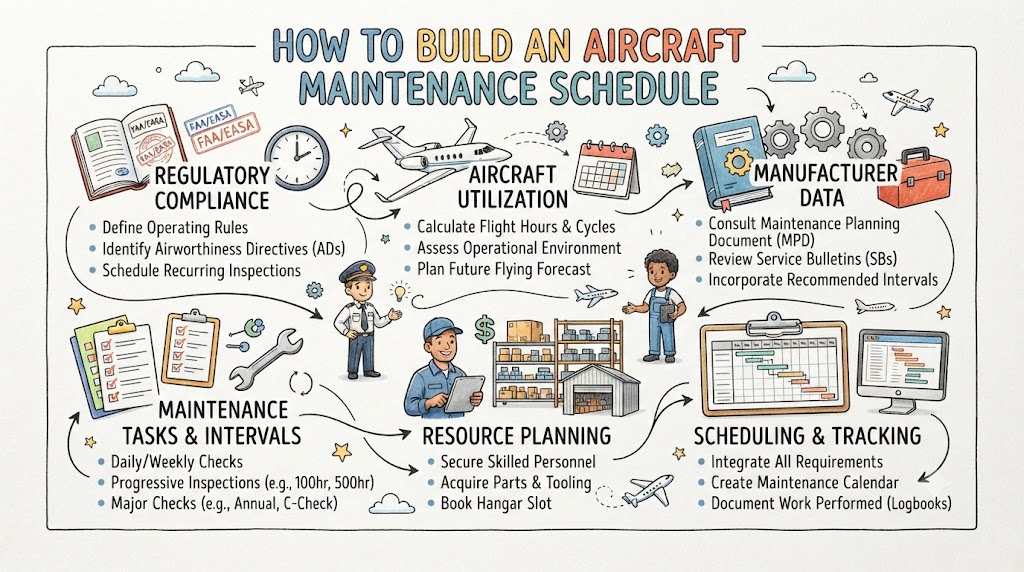
Step 1: Understand Aircraft Requirements
The first step is understanding the specific aircraft being maintained.
Review:
- Aircraft model
- Engine information
- Manufacturer guidance
- Maintenance manuals
- Operational environment
Every aircraft has unique maintenance requirements.
Step 2: Identify Maintenance Categories
Organize maintenance activities into clear groups.
Common categories include:
- Inspections
- Servicing
- Repairs
- Component monitoring
- Replacement planning
A structured approach makes maintenance easier to manage.
Step 3: Establish Maintenance Planning Intervals
Create a schedule based on approved maintenance requirements.
Planning may include:
- Short-term checks
- Periodic inspections
- Long-term maintenance events
Intervals should always follow aircraft-specific guidance.
Step 4: Create a Maintenance Tracking System
A tracking system helps monitor completed and upcoming tasks.
Important tracking information includes:
- Maintenance history
- Inspection dates
- Component status
- Repair records
- Upcoming requirements
Digital maintenance systems can simplify this process.
Step 5: Assign Maintenance Responsibilities
Clear responsibility improves communication.
Responsibilities may involve:
- Aircraft owners
- Operators
- Maintenance organizations
- Flight departments
- Technical teams
Everyone involved should understand their role in maintaining aircraft reliability.
Step 6: Review and Update the Schedule
Aircraft usage and operational needs can change.
Maintenance schedules should be reviewed when there are changes such as:
- Increased flight activity
- Aircraft modifications
- New operational requirements
- Maintenance findings
A flexible schedule helps maintain accuracy.
Types of Aircraft Inspections
Preflight Inspections
Preflight inspections are performed before aircraft operation.
They help identify visible issues such as:
- Leaks
- Damage
- Loose components
- Abnormal conditions
Routine Maintenance Inspections
Routine inspections involve regular evaluations of aircraft systems and components.
Maintenance professionals check:
- Mechanical systems
- Electrical systems
- Aircraft structures
- Operational condition
Detailed Aircraft Inspections
Detailed inspections involve more extensive evaluations based on aircraft requirements.
These inspections help assess:
- System condition
- Component wear
- Structural health
- Maintenance needs
Special Inspections
Special inspections may be required after unusual events such as:
- Hard landings
- Extreme operating conditions
- Unexpected system behavior
- Specific maintenance concerns
Aircraft Maintenance Planning Methods
Calendar-Based Maintenance
Calendar-based maintenance focuses on time periods.
It helps ensure important inspections and servicing tasks are completed regularly.
Flight Hour-Based Maintenance
Flight hour tracking considers aircraft operating time.
This method helps monitor components affected by usage.
Flight Cycle-Based Maintenance
Flight cycles track events such as takeoffs and landings.
This is useful because certain aircraft components experience stress during repeated operational cycles.
Condition-Based Maintenance
Condition-based maintenance uses inspection findings and monitoring data to determine maintenance needs.
It focuses on the actual condition of aircraft components.
Preventive Aircraft Maintenance Best Practices
Effective preventive maintenance includes:
- Regular inspections
- Proper lubrication
- Fluid monitoring
- Component tracking
- Corrosion prevention
- Accurate documentation
- Early identification of issues
Preventive maintenance helps maintain aircraft reliability over time.
Importance of Aircraft Maintenance Records
Maintenance records are essential for aircraft management.
They provide information about:
- Previous repairs
- Inspection history
- Component changes
- Maintenance compliance
- Aircraft condition
Accurate records support better decision-making and aircraft value preservation.
Aircraft Maintenance Scheduling Technology
Modern aviation uses technology to improve maintenance planning.
Digital maintenance systems can support:
- Automated reminders
- Task tracking
- Component monitoring
- Maintenance history management
- Reporting
Technology helps maintenance teams organize complex aircraft requirements.
Common Aircraft Maintenance Scheduling Mistakes
Ignoring Manufacturer Recommendations
Aircraft maintenance should always follow approved guidance.
Poor Record Management
Incomplete records can create challenges during future inspections and planning.
Delaying Preventive Maintenance
Waiting until problems occur can increase operational disruption.
Lack of Communication
Poor coordination between owners, operators, and maintenance teams can create scheduling issues.
Not Considering Aircraft Usage
Maintenance planning should reflect actual aircraft operation.
Aircraft Maintenance Schedule Example
| Maintenance Category | Purpose | Planning Approach |
|---|---|---|
| Preflight Checks | Identify visible issues before operation | Before flight operations |
| Routine Servicing | Maintain aircraft systems | Based on aircraft requirements |
| Scheduled Inspections | Evaluate aircraft condition | According to approved maintenance plans |
| Component Monitoring | Track system health | Based on usage and inspection results |
| Major Maintenance Events | Support long-term reliability | Planned with operational needs |
Planned Maintenance vs Reactive Repairs
| Feature | Planned Maintenance | Reactive Repairs |
|---|---|---|
| Approach | Preventive | Problem-based |
| Safety Planning | Higher control | Less predictable |
| Cost Management | Easier budgeting | Unexpected expenses possible |
| Aircraft Availability | Better planning | Possible disruption |
| Maintenance Organization | Structured | Emergency focused |
| Record Management | Easier tracking | Requires repair documentation |
| Risk Management | Proactive | Reactive |
| Scheduling | Planned in advance | Immediate response |
| Operational Impact | Reduced interruption | Higher disruption risk |
| Component Monitoring | Continuous | Often after failure |
| Resource Planning | Improved | Limited preparation |
| Efficiency | Higher | Lower predictability |
| Long-Term Planning | Supported | More difficult |
| Maintenance Coordination | Organized | Urgent coordination |
| Reliability Support | Strong | Depends on repair response |
How Professional Aircraft Maintenance Providers Help
Professional maintenance organizations support aircraft reliability through:
- Technical inspections
- Repair planning
- Maintenance scheduling
- Component evaluation
- Documentation support
- Troubleshooting assistance
Experienced maintenance teams help operators maintain aircraft according to professional standards.
Choosing an Aircraft Maintenance Partner
Important factors include:
Experience
Choose providers with aircraft maintenance expertise.
Qualifications
Verify technical capabilities and maintenance authorization where applicable.
Maintenance Capabilities
Consider available inspection, repair, and support services.
Documentation Practices
Accurate records are essential for aircraft management.
Communication
Clear communication helps prevent scheduling problems.
Future Trends in Aircraft Maintenance Planning
Aircraft maintenance continues evolving through:
- Predictive maintenance systems
- Digital records
- Data-based monitoring
- Advanced diagnostics
- Improved maintenance analytics
These technologies help maintenance teams make more informed decisions.
Frequently Asked Questions
1. What is an aircraft maintenance schedule?
An aircraft maintenance schedule is a structured plan that organizes inspections, servicing, repairs, and component monitoring activities.
2. Why is aircraft maintenance planning important?
Maintenance planning improves safety, reliability, operational efficiency, and record management.
3. How often should aircraft maintenance be performed?
Maintenance frequency depends on aircraft type, manufacturer guidance, operational usage, and applicable requirements.
4. What factors affect maintenance intervals?
Factors include aircraft design, flight hours, flight cycles, operating environment, and maintenance programs.
5. What are the main types of aircraft inspections?
Common inspection categories include preflight checks, routine inspections, detailed inspections, and special inspections.
6. Why are aircraft maintenance records important?
Records provide a history of inspections, repairs, and component changes.
7. What is preventive aircraft maintenance?
Preventive maintenance focuses on identifying and addressing potential issues before failures occur.
8. How does digital maintenance tracking help?
Digital systems help organize tasks, reminders, records, and component information.
9. What happens if scheduled maintenance is delayed?
Delayed maintenance can affect aircraft availability, reliability, and compliance requirements.
10. How do aircraft operators manage maintenance planning?
Operators use approved maintenance programs, tracking systems, and professional maintenance support.
Conclusion
Building an effective aircraft maintenance schedule is essential for maintaining safety, reliability, and operational efficiency. A well-planned maintenance program helps aircraft owners and operators move from reactive repairs toward proactive management by organizing inspections, tracking components, maintaining records, and addressing issues before they become serious.
Successful aircraft maintenance requires accurate planning, professional expertise, and continuous monitoring. By following manufacturer guidance, using reliable tracking systems, and working with experienced aviation maintenance providers, operators can support long-term aircraft performance and operational readiness.

