
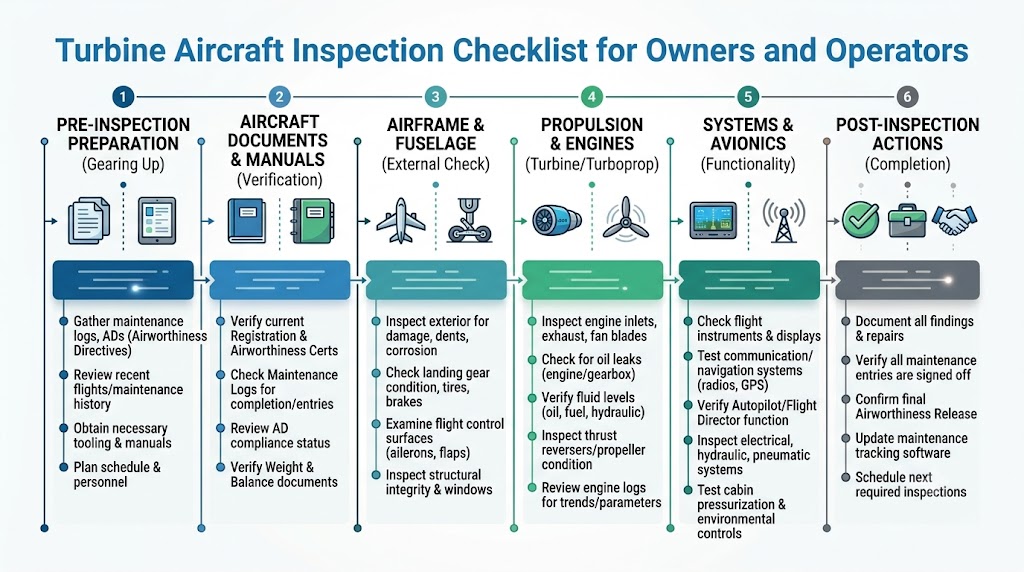
Owning or operating a turbine aircraft requires careful attention to inspections, maintenance records, component history, and aircraft-specific requirements. A well-organized inspection process can help owners and operators understand the condition of their aircraft and ensure that maintenance concerns are properly identified and addressed.
A turbine aircraft inspection checklist can be useful for organizing inspection planning, but it should never replace the aircraft manufacturer’s maintenance documentation, applicable inspection program, regulatory requirements, or work performed by qualified aviation maintenance professionals.
Why Are Turbine Aircraft Inspections Important?
Turbine-powered aircraft contain complex systems that work together during flight. Regular inspections help identify conditions that may require further maintenance or professional evaluation.
Depending on the aircraft, inspection planning may cover:
- Turbine engines
- Fuselage and structure
- Wings
- Flight controls
- Landing gear
- Fuel systems
- Hydraulic systems
- Electrical systems
- Avionics
- Cabin equipment
- Emergency equipment
Inspection requirements vary by aircraft model, engine, components, maintenance program, and applicable regulations.
1. Start With the Aircraft-Specific Inspection Program
One of the most important steps is understanding which inspection program applies to the aircraft.
Owners and operators should review applicable:
- Aircraft maintenance documentation
- Inspection programs
- Manufacturer service information
- Component documentation
- Maintenance records
- Regulatory requirements
A generic checklist can help organize questions, but it cannot replace aircraft-specific technical information.
Before an inspection, make sure the appropriate documentation is available to the maintenance professional responsible for the work.
2. Review Maintenance Records Before the Inspection
Maintenance records provide valuable background information.
Before an inspection, review available records for:
- Previous inspections
- Maintenance findings
- Repairs
- Component replacements
- Engine work
- Overhaul information
- Open maintenance items
- Relevant service information
This history can help maintenance personnel understand what has already been addressed and what may require additional attention.
3. Check Aircraft Hours and Cycles
Aircraft owners and operators should maintain accurate records of relevant operating information.
Depending on the aircraft and component, this may include:
- Flight hours
- Engine hours
- Cycles
- Component time
- Maintenance dates
- Inspection status
Not every component uses the same tracking method, so records should follow the applicable aircraft and component requirements.
4. Exterior Aircraft Inspection Checklist
The aircraft exterior is an important part of inspection planning.
General areas that may receive attention include:
- Fuselage
- Wings
- Empennage
- Flight-control surfaces
- Doors
- Access panels
- Windows
- Windshields
- Exterior lights
- Antennas
- Visible fasteners
- Areas showing possible corrosion or damage
A visual observation is not necessarily a complete technical inspection. Any concern should be evaluated according to appropriate maintenance procedures.
5. Turbine Engine Inspection Checklist
The engine deserves particular attention because it is a critical part of the aircraft’s propulsion system.
General inspection-planning considerations may include:
- Engine exterior condition
- Visible signs of leakage
- Inlet area
- Exhaust area
- Engine mounts
- Connections
- Accessories
- Engine maintenance history
- Inspection status
- Relevant service information
Engine inspection requirements vary considerably by engine model.
Owners should avoid relying on a generic engine checklist when determining actual maintenance requirements.
6. Review Engine Maintenance History
Engine records can provide important information about previous maintenance activity.
Where applicable, owners and operators should understand available information regarding:
- Engine inspections
- Repairs
- Overhauls
- Component replacements
- Engine hours
- Cycles
- Previous findings
- Relevant maintenance documentation
Keeping engine records organized can make future maintenance planning easier.
7. Fuel System Inspection Considerations
The fuel system is another important area of aircraft inspection planning.
General areas may include:
- Fuel tanks
- Fuel lines
- Connections
- Related components
- Visible signs of leakage
- Fuel system records
Fuel-system maintenance should always follow aircraft-specific technical documentation and qualified maintenance procedures.
8. Landing Gear Inspection Checklist
Landing gear inspections can be an important part of an overall aircraft inspection.
General areas may include:
- Main landing gear
- Nose landing gear
- Tires
- Wheels
- Braking system
- Visible hydraulic components
- Gear doors
- Linkages
- Related maintenance records
The exact inspection criteria depend on the aircraft design and applicable maintenance requirements.
9. Flight Control System Inspection
Flight controls require appropriate inspection and maintenance attention.
General areas may include:
- Primary flight-control surfaces
- Secondary flight controls
- Visible control components
- Actuation systems
- Related linkages
- Associated hardware
- Maintenance history
Owners should not attempt to determine flight-control serviceability through a basic visual checklist alone.
Technical inspection and adjustment requirements should be handled according to the aircraft’s applicable maintenance documentation.
10. Hydraulic System Inspection
Many turbine aircraft use hydraulic systems for important aircraft functions.
Inspection planning may consider:
- Hydraulic lines
- Connections
- Reservoir-related components
- Actuators
- Visible leakage
- System history
- Maintenance records
Any suspected hydraulic problem should receive appropriate professional evaluation rather than being treated as a simple visual issue.
11. Electrical System Inspection
Electrical systems support numerous aircraft functions.
General inspection areas may include:
- Wiring
- Connections
- Batteries
- Electrical components
- Exterior lighting
- Interior lighting
- Signs of damage
- Maintenance records
Electrical inspection and repair requirements vary by aircraft and equipment.
12. Avionics Inspection Checklist
Modern turbine aircraft may contain extensive avionics systems.
Depending on the aircraft, inspection planning may include:
- Communication equipment
- Navigation equipment
- Flight displays
- Transponders
- Antennas
- Wiring
- Associated equipment
- Applicable maintenance documentation
Owners should maintain appropriate records for avionics work and ensure that applicable inspection, testing, and certification requirements are followed.
13. Cabin and Interior Inspection
The aircraft interior should also form part of an organized inspection process.
Potential areas include:
- Passenger seats
- Seat belts
- Restraint systems
- Cabin panels
- Doors
- Windows
- Interior lighting
- Emergency equipment
- Oxygen equipment where applicable
Not every aircraft has the same equipment, so the applicable aircraft documentation should determine what needs to be inspected.
14. Emergency and Safety Equipment
Safety equipment should be appropriately tracked and maintained.
Depending on the aircraft, this may include:
- Fire extinguishers
- Emergency exits
- Emergency lighting
- First-aid equipment
- Oxygen equipment
- Life-saving equipment
- Other required emergency equipment
Owners should maintain records for applicable equipment and follow the relevant inspection requirements.
15. Check for Corrosion and Structural Concerns
Environmental exposure can influence aircraft maintenance considerations.
Owners and operators should be aware of conditions involving:
- Moisture
- Salt exposure
- Dust
- Corrosive environments
- Outdoor storage
- Temperature changes
General observations of corrosion or structural concerns should be documented and referred to qualified maintenance personnel for appropriate evaluation.
16. Review Component History
Aircraft contain many components with their own maintenance histories.
Depending on the aircraft, owners may need to track:
- Component identification
- Installation history
- Maintenance
- Inspections
- Repairs
- Replacements
- Overhaul status
- Applicable operating information
Do not assume that all components follow the same tracking requirements.
17. Pay Attention to Previous Inspection Findings
An inspection should not be treated as an isolated event.
Previous findings can provide useful information about recurring or previously identified maintenance concerns.
Before an inspection, review:
- Previous discrepancies
- Corrective actions
- Deferred items where applicable
- Repeated findings
- Component replacements
- Follow-up requirements
This can help create a more complete picture of the aircraft’s maintenance history.
18. Do Not Ignore Unusual Aircraft Behavior
Owners and pilots may notice changes during normal operation that deserve professional attention.
Examples may include:
- Unusual sounds
- Changes in vibration
- Changes in aircraft handling
- Unusual indications
- Unexpected system behavior
- Fluid leakage
These observations should be communicated clearly to qualified maintenance personnel.
Pilots and owners should avoid attempting to diagnose complex aircraft problems without appropriate technical expertise.
19. Avoid Using Incorrect Replacement Parts
A replacement part should never be selected simply because it looks similar to the original.
Before purchasing or replacing a component, verify applicable:
- Part number
- Manufacturer
- Aircraft application
- Component configuration
- Technical documentation
- Traceability information where applicable
Incorrect components can create unnecessary maintenance complications and may not be suitable for the aircraft.
20. Keep Inspection Records Organized
Good recordkeeping is one of the most useful habits for aircraft owners and operators.
Maintain applicable records relating to:
- Inspections
- Repairs
- Component replacements
- Engine maintenance
- Service information
- Findings
- Corrective actions
- Component history
Organized records make it easier to understand what work has been completed and what may require attention in the future.
Turbine Aircraft Inspection Checklist
The following high-level checklist can help owners organize inspection planning.
Documentation
- Aircraft maintenance records reviewed
- Applicable inspection program identified
- Previous findings reviewed
- Open maintenance items reviewed
- Component history available
- Engine records reviewed
Exterior
- Fuselage
- Wings
- Empennage
- Flight-control surfaces
- Doors and access panels
- Windows and windshields
- Exterior lights
- Antennas
- Visible signs of corrosion or damage
Engine
- Engine condition
- Visible leakage concerns
- Inlet area
- Exhaust area
- Engine mounts
- Connections
- Accessories
- Engine maintenance history
Landing Gear
- Main landing gear
- Nose landing gear
- Tires
- Wheels
- Brakes
- Related components
- Maintenance records
Aircraft Systems
- Fuel system
- Hydraulic system
- Electrical system
- Avionics
- Flight-control system
Cabin and Safety Equipment
- Seats
- Restraints
- Emergency exits
- Emergency equipment
- Fire-extinguishing equipment
- Oxygen equipment where applicable
- Interior condition
Records
- Inspection findings documented
- Corrective maintenance recorded
- Component history updated
- Engine records updated
- Upcoming requirements reviewed
Common Turbine Aircraft Inspection Mistakes
Even well-maintained aircraft can encounter inspection-planning problems.
Relying on a Generic Checklist
A generic checklist is useful for organization but cannot replace aircraft-specific documentation.
Ignoring Previous Findings
Failing to review previous inspection records can make it harder to recognize recurring concerns.
Poor Recordkeeping
Missing or disorganized records can complicate maintenance planning.
Delaying Required Inspections
Owners should track applicable inspection requirements and plan accordingly.
Overlooking Engine History
Engine records are an important part of understanding the aircraft’s maintenance background.
Treating a Visual Check as a Complete Inspection
Some maintenance concerns cannot be identified through casual observation.
Using Incorrect Parts
Replacement components should be verified against applicable technical information.
Failing to Communicate Operational Concerns
Unusual noises, vibration, indications, or handling changes should be appropriately reported.
How Owners Can Improve Inspection Planning
A structured approach can make aircraft maintenance management more effective.
1. Maintain Complete Records
Keep inspection, engine, component, and maintenance records organized.
2. Track Hours and Cycles
Where applicable, maintain accurate operating information for the aircraft and its components.
3. Review History Before Inspections
Previous findings can provide valuable context for upcoming maintenance.
4. Use Aircraft-Specific Documentation
Always prioritize the documentation applicable to the specific aircraft and components.
5. Plan Ahead
Avoid waiting until the last moment to arrange required inspections or maintenance.
6. Communicate Clearly
Share operational observations and maintenance concerns with qualified professionals.
7. Verify Replacement Components
Confirm part identification and compatibility before purchasing or replacing components.
8. Work With Qualified Maintenance Professionals
Professional inspection and maintenance support remain essential for turbine aircraft.
What Should Owners Do After an Inspection?
Once an inspection is completed, owners and operators should review the available findings with the appropriate maintenance personnel.
Important areas to understand may include:
- Identified discrepancies
- Completed corrective maintenance
- Outstanding items where applicable
- Component status
- Updated records
- Upcoming inspection requirements
Owners should avoid independently determining aircraft serviceability based solely on a general checklist.
The applicable maintenance program and qualified aviation professionals should guide the required maintenance decisions.
Questions Owners Should Ask Before an Inspection
Before scheduling or starting an inspection, consider asking:
- Which inspection program applies to this aircraft?
- Are previous inspection findings available?
- Are there outstanding maintenance items?
- Are engine hours and cycles properly recorded?
- Are relevant component records available?
- Is there manufacturer service information that should be reviewed?
- Are there known operational concerns that should be reported?
- Are any major components approaching applicable maintenance requirements?
- What records should be updated after the inspection?
- What follow-up may be required after findings are identified?
These questions can help owners participate more effectively in the maintenance-planning process.
Frequently Asked Questions
Q1. What should be included in a turbine aircraft inspection checklist?
A high-level checklist can include documentation, exterior condition, engine records, landing gear, flight controls, fuel, hydraulic, electrical, avionics, cabin, emergency equipment, and maintenance records.
Q2. How often should turbine aircraft be inspected?
There is no universal inspection interval for every turbine aircraft. Requirements depend on the aircraft, engine, components, maintenance program, manufacturer documentation, and applicable regulations.
Q3. What should owners review before an inspection?
Owners should review applicable maintenance records, previous findings, component history, engine records, inspection status, and relevant manufacturer information.
Q4. What engine areas should be considered during an inspection?
General planning may include engine condition, visible leakage concerns, inlet and exhaust areas, mounts, connections, accessories, and engine maintenance history. Detailed inspection requirements depend on the specific engine.
Q5. Why are aircraft maintenance records important?
Records provide information about previous inspections, repairs, component replacements, engine work, and other maintenance activities.
Q6. Should owners perform turbine aircraft inspections themselves?
Owners can organize records and communicate operational observations, but technical aircraft inspections should be performed according to applicable requirements by appropriately qualified aviation maintenance professionals.
Q7. Why is an aircraft-specific checklist important?
Different aircraft and engines have different systems, components, limitations, and inspection requirements. An aircraft-specific checklist helps ensure that the applicable maintenance program is being followed.
Q8. What should operators do if an inspection identifies a concern?
The finding should be appropriately documented and evaluated through the applicable maintenance procedures. Qualified maintenance personnel should determine the appropriate corrective action.
Final Thoughts
A turbine aircraft inspection checklist is a useful planning tool for owners and operators, but it should never be considered a replacement for aircraft-specific maintenance documentation or professional inspection procedures. The most effective inspection planning combines accurate records, manufacturer guidance, component history, engine information, system awareness, and qualified maintenance support. Owners and operators can contribute significantly by keeping records organized, tracking applicable operating information, reporting unusual aircraft behavior, and preparing the necessary documentation before inspections. For turbine aircraft, good maintenance planning is not simply about checking boxes. It is about maintaining a clear understanding of the aircraft’s history, requirements, and inspection status while ensuring that technical decisions are handled through appropriate aviation maintenance practices.

