
Introduction
A thorough piston aircraft inspection is one of the most important steps a pilot can take before departure. Small abnormalities involving fuel, oil, control surfaces, tires, propellers, or engine components can become significant concerns if they are overlooked. A systematic inspection helps pilots avoid relying entirely on memory and encourages a consistent approach to aircraft readiness. However, a general checklist should never replace the aircraft manufacturer’s approved checklist, flight manual, maintenance instructions, or applicable aviation requirements. Pilots should always use aircraft-specific procedures and seek qualified maintenance assistance whenever an issue is unclear. For aircraft owners, a disciplined inspection routine can also help identify developing maintenance concerns before they become more complicated. Ultimately, safer flying begins with careful preparation, attention to detail, and the willingness to delay a flight when an aircraft’s condition is uncertain.
Why a Piston Aircraft Inspection Checklist Matters
Piston-powered aircraft contain numerous mechanical, electrical, fuel, control, and structural systems that work together during flight. A preflight inspection provides an opportunity to identify visible abnormalities before the aircraft leaves the ground.
Using a systematic checklist can help pilots:
- Reduce the likelihood of overlooking important inspection areas
- Establish a consistent preflight routine
- Identify visible damage or abnormal conditions
- Detect possible fuel, oil, or other fluid leaks
- Confirm that important components appear suitable for operation
- Review recent maintenance or known discrepancies
- Make better go/no-go decisions
- Communicate maintenance concerns clearly
A checklist is particularly valuable when a pilot is dealing with distractions, unfamiliar airports, changing weather, or time pressure.
The objective is not simply to complete the list as quickly as possible. The objective is to understand the aircraft’s condition and recognize anything that requires further attention.
Before Starting the Inspection
Before physically inspecting the aircraft, pilots should review information relevant to that specific aircraft.
This may include:
- The aircraft manufacturer’s approved checklist
- Flight manual or pilot’s operating handbook
- Aircraft maintenance status
- Recent maintenance activity
- Known discrepancies
- Previous squawks
- Aircraft configuration
- Current operating conditions
- Fuel requirements
- Relevant equipment limitations
Recent maintenance deserves particular attention. If an aircraft has just undergone maintenance, pilots should understand whether any operational considerations or follow-up items apply to the intended flight.
The inspection should be performed without unnecessary distractions. Rushing because of a departure schedule can increase the likelihood of missing something important.
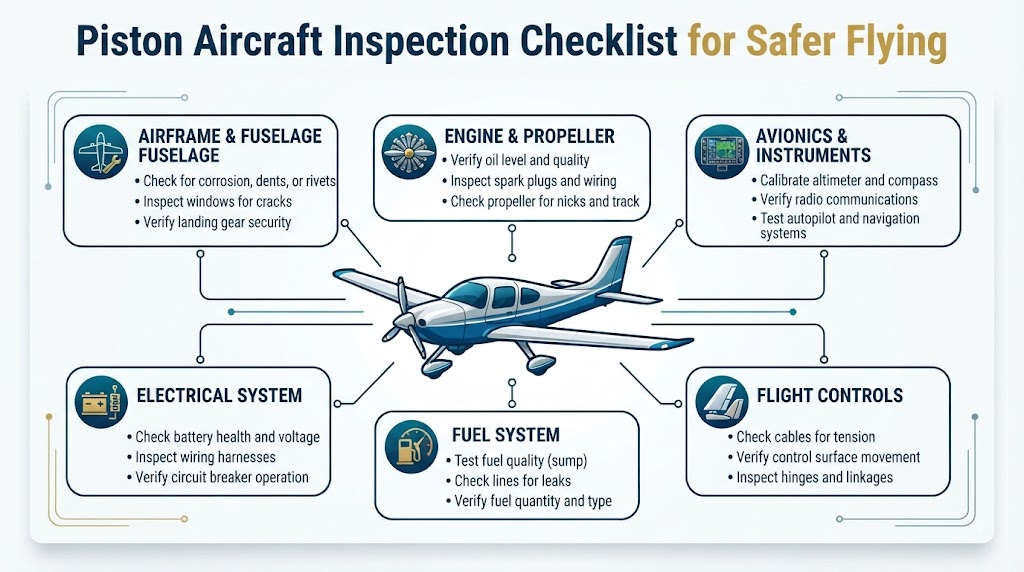
Piston Aircraft Inspection Checklist
The following provides a general inspection framework. It is not a substitute for the aircraft-specific checklist supplied by the manufacturer.
General Aircraft Condition
Start with an overall look at the aircraft before concentrating on individual components.
Look for:
- Visible structural damage
- Loose or missing components
- Unusual wear
- Signs of corrosion
- Foreign objects
- Unusual stains or residue
- Evidence of recent damage
- Abnormal conditions around accessible areas
The purpose is to develop an overall picture of the aircraft’s condition.
Not every dent, stain, or mark automatically means an aircraft is unsafe. However, anything unusual should be evaluated according to the appropriate aircraft procedures rather than dismissed without investigation.
Wings and Control Surfaces
Wings and control surfaces deserve careful attention because they are essential to aircraft control and aerodynamic performance.
Depending on the aircraft and approved inspection procedure, pilots may visually examine:
- Wing surfaces
- Ailerons
- Flaps
- Hinges
- Control connections where accessible
- Fasteners
- Control surfaces
- Visible damage
- Unusual movement or condition
Look for cracks, significant dents, loose components, or other abnormalities.
Pilots should only manipulate or test controls in the manner permitted by the aircraft’s approved procedures. If a control surface appears damaged or behaves abnormally, qualified maintenance personnel should evaluate the aircraft before flight when appropriate.
Fuselage and Empennage
The fuselage and tail assembly should receive a deliberate inspection.
Areas of attention may include:
- Fuselage skin
- Vertical stabilizer
- Horizontal stabilizer
- Rudder
- Elevator
- Hinges
- Accessible attachment points
- Fasteners
- Visible corrosion
- Signs of impact or other damage
The tail section can sometimes receive less attention than the engine area, particularly when pilots are in a hurry. Following a consistent inspection sequence helps prevent important areas from being overlooked.
Landing Gear, Tires, and Brakes
Landing gear problems can affect taxiing, takeoff, landing, and ground handling.
Visually inspect applicable components for:
- Tire condition
- Wheels
- Landing gear assemblies
- Brakes
- Struts where applicable
- Visible fluid leakage
- Unusual wear
- Damage
- Foreign objects
Tire condition should be evaluated according to aircraft-specific requirements rather than a universal visual rule.
Similarly, pilots should not assume that an unusual brake indication, damaged tire, or abnormal landing gear condition is insignificant.
Propeller and Spinner
The propeller deserves careful attention because it operates under demanding conditions and is critical to engine and aircraft operation.
During the inspection, look for visible concerns involving:
- Propeller blades
- Blade surfaces
- Spinner
- Cracks
- Significant nicks or impact marks
- Unusual damage
- Loose or abnormal components
- Evidence of fluid contamination where relevant
Propeller damage should never be casually dismissed. An abnormality that appears minor may require professional evaluation.
If a pilot is uncertain about the condition of a propeller or spinner, the appropriate course is to consult qualified maintenance personnel before flight.
Engine Compartment
The engine compartment should be inspected carefully using the aircraft-specific procedure.
Depending on the aircraft, visible inspection areas may include:
- Oil leaks
- Fuel leaks
- Hoses
- Wiring
- Connections
- Belts where applicable
- Engine mounts where visible
- Loose components
- Signs of overheating
- Unusual residue
- Contamination
- Evidence of damage
The objective is not to perform maintenance during the preflight. Instead, the pilot is looking for conditions that could indicate a maintenance issue.
Pilots should avoid adjusting, tightening, disconnecting, or repairing components unless they are specifically authorized and qualified to perform that work.
Engine Oil
Engine oil is essential to piston-engine operation, making the oil inspection an important part of aircraft preparation.
Pilots should follow the aircraft and engine manufacturer’s procedure for checking oil.
General considerations can include:
- Oil level
- Evidence of leaks
- Unusual oil consumption
- Abnormal appearance
- Contamination
- Proper servicing
There is no universal oil quantity that applies to every piston aircraft. The correct procedure and quantity depend on the specific aircraft and engine.
An unexplained change in oil level or evidence of an unusual leak should receive appropriate attention rather than being automatically treated as normal.
Fuel System
Fuel-related issues can have serious consequences, so the fuel system should be checked according to the aircraft-specific procedure.
General areas may include:
- Fuel quantity
- Fuel caps
- Fuel drains
- Visible fuel leaks
- Accessible fuel lines
- Fuel contamination checks where required
- Correct fuel type
Fuel quantity should be verified using the methods specified for the aircraft rather than relying solely on assumptions or an instrument indication.
Fuel caps should also be properly secured after inspection or servicing.
If fuel contamination or an unexplained leak is suspected, the issue should be addressed before flight according to applicable procedures.
Exhaust and Cooling System
The exhaust and cooling systems deserve attention because problems in these areas can affect engine operation and aircraft safety.
Visually inspect applicable areas for:
- Cracks
- Loose components
- Burn marks
- Abnormal discoloration
- Damaged heat shields
- Cooling baffle issues
- Evidence of overheating
- Unusual residue
The exact inspection method varies by aircraft and engine configuration.
Because exhaust components can become extremely hot during operation, pilots should follow appropriate procedures and avoid unsafe handling.
Battery and Electrical System
Electrical systems support numerous aircraft functions, including starting, communication, navigation, lighting, and other equipment.
A general visual inspection may include accessible areas around:
- Battery installation
- Electrical connections
- Wiring
- Circuit protection
- Corrosion
- Signs of overheating
- Damaged insulation
- Unusual odors
Electrical maintenance can involve significant hazards and should not be attempted casually. If wiring appears damaged or there are signs of overheating or electrical problems, qualified personnel should evaluate the issue.
Cockpit and Instruments
Once the exterior inspection is complete, attention turns to the cockpit.
Depending on the aircraft-specific checklist, pilots may verify:
- Flight instruments
- Engine instruments
- Warning indicators
- Switches
- Controls
- Circuit breakers
- Seats
- Restraint systems
- Doors
- Latches
- Avionics
- Radios
- Navigation equipment
- Required equipment
Operational checks should be performed exactly as specified in the aircraft’s approved procedures.
A cockpit inspection is not simply about confirming that switches are in the correct position. Pilots should also pay attention to abnormal indications, warning lights, unusual smells, damaged equipment, or anything that appears different from normal.
Fuel, Oil, and Other Fluid Leaks
Fluid evidence is one of the conditions that should receive careful attention during an inspection.
Look for:
- Fresh fluid
- Stains
- Unusual residue
- Fluid pooling
- Fuel odor
- Oil accumulation
- Evidence of recurring leakage
Not every stain necessarily indicates an active problem, but pilots should avoid making assumptions about the source or significance of unexplained fluid evidence.
If the source or severity of a leak is uncertain, appropriate maintenance personnel should evaluate the aircraft before flight.
Final Walk-Around
A final walk-around is an important opportunity to confirm the aircraft’s configuration before departure.
Depending on the aircraft and checklist, the pilot may verify that:
- Required covers have been removed
- Tie-downs have been removed
- Fuel caps are secure
- Access panels are properly secured
- Doors are closed and secured
- Loose equipment has been removed
- Control surfaces are configured as required
- The aircraft is ready for the next stage of operation
This final look can catch problems introduced during fueling, loading, passenger boarding, or aircraft preparation.
Warning Signs That Should Never Be Ignored
Some findings deserve immediate attention rather than being treated as minor inconveniences.
Examples include:
- Significant structural damage
- Cracks
- Suspected fuel leaks
- Significant oil leakage
- Propeller damage
- Loose or missing components
- Severe corrosion
- Damaged control surfaces
- Evidence of overheating
- Unexplained fluid loss
- Abnormal engine indications
- Unusual smells
- Important systems not functioning as required
The correct response is not to guess whether the aircraft can safely fly.
Instead, pilots should follow the aircraft’s applicable procedures and consult appropriately qualified maintenance personnel when necessary.
A delayed flight is inconvenient. Taking an aircraft into the air with an unresolved safety concern can have much more serious consequences.
Pilot Preflight Inspection vs. Maintenance Inspection
A common misunderstanding is treating a pilot’s preflight inspection and a formal maintenance inspection as the same activity.
They are not.
Pilot Preflight Inspection
A pilot’s preflight inspection is generally focused on determining whether the aircraft appears ready for the intended operation.
It can include:
- Visual inspection
- Checking aircraft condition
- Reviewing relevant information
- Identifying obvious abnormalities
- Performing required operational checks
The pilot follows the aircraft-specific checklist and remains within the scope of their responsibilities and qualifications.
Maintenance Inspection
A maintenance inspection is different.
Qualified aviation maintenance personnel may perform more detailed procedures involving:
- Specialized inspection methods
- Maintenance documentation
- Component evaluation
- Troubleshooting
- Testing
- Corrective maintenance
- Maintenance-specific requirements
A pilot should not attempt to replace a professional maintenance inspection with a basic preflight walk-around.
Both activities have different purposes and complement one another.
Documentation and Maintenance Records
Aircraft records provide valuable information about an aircraft’s maintenance history and known condition.
Owners and operators should maintain appropriate records and review relevant information when preparing an aircraft for operation.
Useful information may include:
- Recent maintenance
- Recorded discrepancies
- Corrective actions
- Known limitations
- Maintenance history
- Inspection status
- Previous squawks
If a pilot discovers a discrepancy, it should be communicated and documented through the appropriate process.
Good documentation helps create continuity between pilots, owners, operators, and maintenance personnel.
When Should an Aircraft Be Grounded?
There are situations where continuing toward a planned flight is not an appropriate choice.
An aircraft may require further evaluation when there is:
- Significant structural damage
- Suspected fuel leakage
- Serious oil leakage
- Propeller damage
- Control-system concerns
- Unexplained engine abnormalities
- Important equipment that does not function as required
- A condition that creates uncertainty about airworthiness
The specific decision depends on the aircraft, applicable procedures, operating requirements, and nature of the discrepancy.
When there is uncertainty, professional maintenance advice can be essential.
Pilots should never allow schedule pressure, passenger expectations, or inconvenience to replace sound safety judgment.
Common Piston Aircraft Inspection Mistakes
Rushing the Inspection
Moving too quickly can cause important areas to be overlooked. A systematic inspection is more valuable than a fast inspection.
Relying Entirely on Memory
Even experienced pilots can forget checklist items. The approved aircraft checklist provides an important structure.
Skipping Items Because the Aircraft Was Recently Flown
An aircraft’s condition can change between flights. Previous operation does not eliminate the need for a current inspection.
Ignoring Small Abnormalities
A small leak, unusual stain, damaged fastener, or unfamiliar sound may deserve further attention.
Failing to Review Recent Maintenance
Recent maintenance may be relevant to the aircraft’s current condition and operation.
Not Checking for Leaks
Fuel and oil leaks should be taken seriously and evaluated according to the appropriate procedures.
Assuming Cosmetic Damage Is Harmless
Some damage may be purely cosmetic, while other damage can have operational significance. When uncertain, seek qualified evaluation.
Attempting Unqualified Repairs
A preflight inspection is not an invitation to perform maintenance beyond the pilot’s qualifications or authorization.
Allowing Time Pressure to Influence the Inspection
A departure schedule should never be the reason for skipping or rushing safety-critical preparation.
How to Build a Consistent Inspection Routine
A reliable inspection routine can make preflight preparation more effective.
1. Use the Aircraft-Specific Checklist
Always begin with the checklist approved or provided for the aircraft.
2. Follow a Consistent Sequence
Move around the aircraft in a predictable pattern so that inspection areas are less likely to be forgotten.
3. Minimize Distractions
Avoid unnecessary interruptions during the inspection whenever possible.
4. Look Rather Than Simply Touch
A checklist should encourage active observation. Look for changes, abnormalities, and conditions that do not match expectations.
5. Investigate Unusual Findings
Do not automatically dismiss something simply because it appears small.
6. Record Discrepancies
Use the appropriate aircraft or operator process for documenting maintenance concerns.
7. Ask for Professional Help
If the condition of a component is uncertain, involve appropriately qualified maintenance personnel.
8. Never Let Schedule Pressure Override Safety
The decision to delay a flight is sometimes the correct decision.
Piston Aircraft Inspection Checklist: Quick Reference
Use this as a general reference alongside the aircraft manufacturer’s approved checklist:
- Review aircraft-specific documentation and checklist
- Review recent maintenance and known discrepancies
- Check general aircraft condition
- Inspect wings and accessible control surfaces
- Inspect fuselage and empennage
- Check landing gear and tires
- Check brakes where applicable
- Inspect propeller and spinner
- Inspect accessible engine areas
- Check engine oil according to the approved procedure
- Inspect for fuel leaks and contamination as applicable
- Check exhaust and cooling-system areas
- Review accessible electrical-system areas
- Inspect cockpit and instruments
- Verify doors, restraints, and relevant equipment
- Complete the required final walk-around
- Address unexplained abnormalities before flight
Important: This is a general reference checklist, not a replacement for the aircraft manufacturer’s approved checklist, flight manual, maintenance documentation, or applicable aviation requirements.
How Professional Maintenance Supports Safer Aircraft Operations
A pilot’s preflight inspection is an essential safety activity, but it is only one part of responsible aircraft ownership and operation.
Professional maintenance support becomes particularly important when an inspection reveals an abnormal condition that requires technical evaluation.
Aircraft maintenance professionals can help investigate concerns involving engines, airframes, electrical systems, fuel systems, landing gear, propellers, and other aircraft components.
For aircraft owners and operators working with EXECUTIVEAIRREPAIR.COM, maintaining clear communication between pilots and qualified maintenance personnel can help ensure that identified concerns are properly evaluated rather than simply overlooked.
The goal is not to eliminate every minor imperfection from an aircraft. It is to ensure that relevant conditions are understood, appropriately evaluated, and addressed according to established procedures.
Frequently Asked Questions
1. What should be included in a piston aircraft inspection checklist?
A piston aircraft inspection checklist should cover the aircraft’s exterior, wings, control surfaces, fuselage, empennage, landing gear, propeller, engine area, fluids, fuel system, cockpit, instruments, and other items specified by the aircraft manufacturer.
2. Why is a piston aircraft preflight inspection important?
A preflight inspection helps pilots identify visible damage, leaks, abnormal conditions, and other potential concerns before flight. It also creates a consistent process for assessing aircraft readiness.
3. What should pilots check on a piston aircraft before flight?
Pilots should follow the aircraft manufacturer’s approved checklist and inspect the applicable exterior, engine, fuel, fluid, landing gear, control, cockpit, and equipment areas.
4. How often should a piston aircraft be inspected?
Inspection requirements vary according to the aircraft, engine, operating environment, maintenance program, and applicable aviation requirements. Pilots and owners should follow the applicable aircraft documentation and regulations rather than relying on a universal interval.
5. What should I check for around a piston aircraft engine?
Pilots should follow the aircraft-specific procedure and look for relevant visible conditions such as oil or fuel leakage, damaged components, loose items, unusual residue, signs of overheating, and other abnormalities.
6. What are common warning signs during an aircraft inspection?
Warning signs can include significant cracks, unusual leaks, propeller damage, loose components, severe corrosion, damaged control surfaces, abnormal smells, overheating evidence, and unexplained engine indications.
7. When should a piston aircraft be grounded?
An aircraft should receive appropriate evaluation when a condition raises a serious question about its safety or airworthiness. Examples can include significant structural damage, suspected fuel leakage, propeller damage, control concerns, or unexplained engine abnormalities.
8. What is the difference between a preflight inspection and a maintenance inspection?
A preflight inspection is a pilot’s operational check of aircraft condition before flight. A maintenance inspection is a more detailed technical evaluation performed within the qualifications and responsibilities of appropriately authorized maintenance personnel.
9. Can a pilot perform an aircraft inspection without a mechanic?
Pilots can perform the preflight inspection required by the aircraft’s procedures and applicable operating requirements. However, a pilot should not treat a routine preflight as a substitute for qualified maintenance inspection or perform work beyond their authorization and qualifications.
10. Why are aircraft maintenance records important?
Maintenance records provide information about inspections, repairs, discrepancies, and aircraft history. Reviewing appropriate records can help pilots and owners understand the aircraft’s maintenance status and communicate effectively with maintenance personnel.
Final Thoughts
A piston aircraft inspection should be approached as a deliberate safety process rather than a quick walk around the airplane. Using a consistent aircraft-specific checklist helps pilots examine important areas and recognize conditions that may require further attention. Fuel, oil, propellers, control surfaces, landing gear, engines, electrical systems, and cockpit equipment all deserve appropriate attention. Just as importantly, pilots should understand the limits of a routine preflight inspection and know when qualified maintenance support is necessary. When an abnormal condition is discovered, delaying a flight for proper evaluation can be the responsible decision. Careful preparation, accurate documentation, sound judgment, and professional maintenance support all contribute to safer piston aircraft operations.

